Soniox v6 beside v5 on 1,922 test streams: what changes for voice agents on 15 December
Soniox removes its v5 real-time speech-to-text model on 15 December 2026 and answers v5 requests with v6. A voice agent then gets prices, booking codes and pauses in a different form without anyone changing it. We ran both on 1,922 test streams, phone-quality audio included: here is what breaks, what to check first, and the measurements behind it.
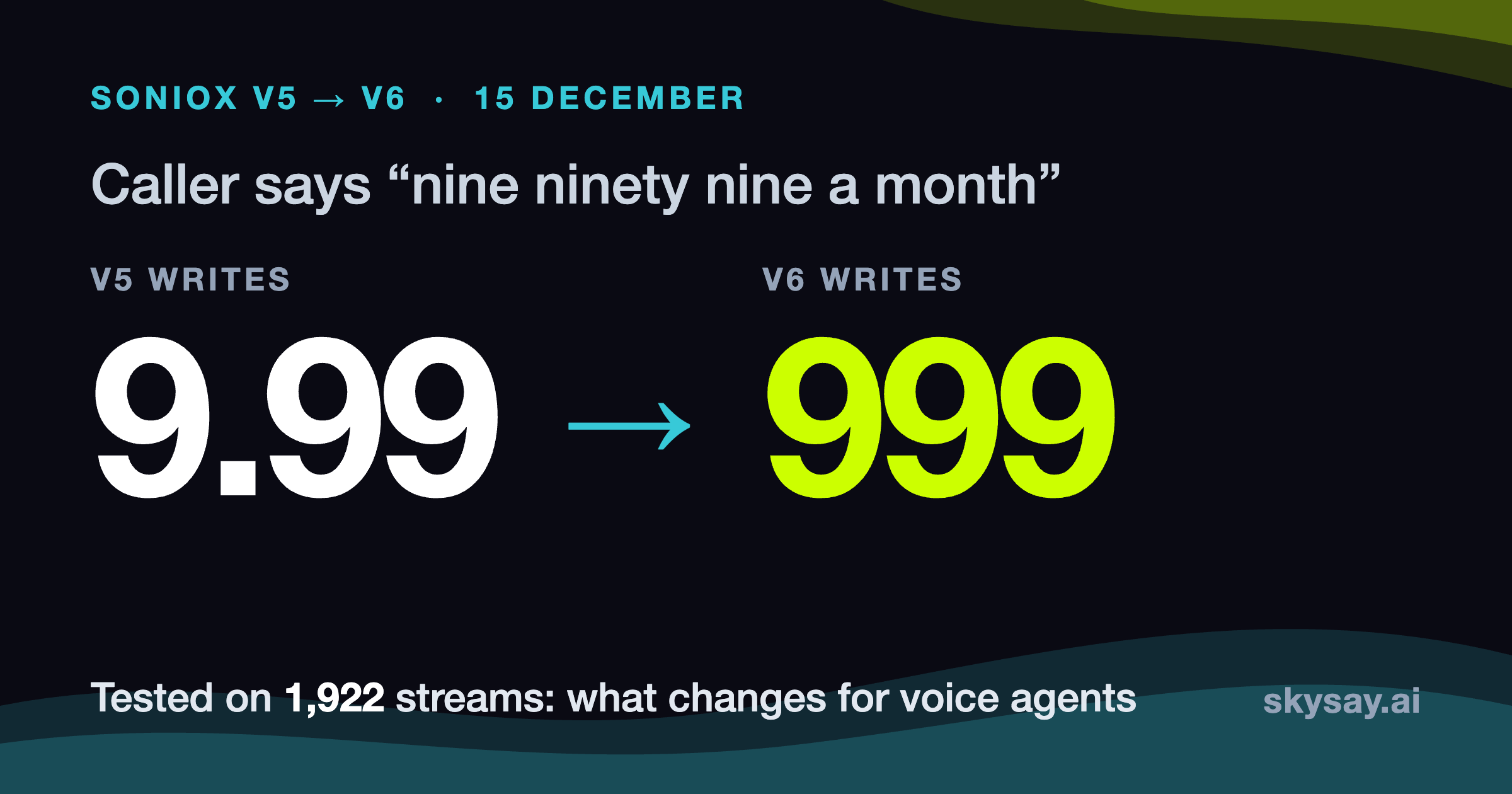
A caller tells your voice agent what the shop quoted.
- Agent: "What price did the shop quote you?"
- Caller: "Nine ninety nine a month."
Today the agent reads "9.99 a month" in its transcript. From 15 December 2026 it reads "999 a month", and an agent that records the amount from the transcript records 999. Nobody touched the agent.
That is the day Soniox removes v5, its real-time speech-to-text model. Its changelog says requests for v5 are routed to v6 after that date. So if your agent listens through Soniox real-time, on any platform, it moves to v6 within weeks whether you change anything or not.
We ran v5 and v6 on the same audio, 1,922 streams in all with phone quality included, to see what an agent will hear differently. Most of it is the same. The differences below are the ones that can cost a caller a correction or break a check in your workflow, followed by what to do about each.
What changes on a call
A price said the casual way loses its decimal point. "Nine ninety nine a month" was written "9.99 a month" by v5 and "999 a month" by v6. v6 is doing what Soniox says it does: writing the words that were spoken. The decimal point was v5's guess.
Amounts arrive as words, not symbols.
| The caller says | v5 writes | v6 writes |
|---|---|---|
| "fifteen dollars and twenty cents" | $15.20 | 15 dollars and 20 cents |
| "one hundred twenty three dollars and forty five cents" | $123.45 | 123 dollars and 45 cents |
A language model handles both forms. A regular expression looking for "$" does not.
Codes lose the hyphen v5 used to add.
- Agent: "What is your booking reference?"
- Caller: "N P three eight B X."
- v5 wrote "NP3-8BX" in 4 of 6 runs and "NP38BX" in 2. v6 wrote "NP38BX" in 6 of 6.
That helps a check against a stored "NP38BX". It does not help if the stored code is "NP-38-BX": neither model writes that, and an exact comparison fails on both.
Dates and spelled names come out as spoken. For "the third of April, nineteen eighty nine", v5 wrote "3 April 1989" and v6 wrote "the 3rd of April, 1989". For "Siobhan O'Connor, that is S I O B H A N", v5 wrote "Siobhán O'Connor" in 5 of 6 runs and "Shavon O'Connor" in 1. v6 wrote "Siobhan O'Connor" in 6 of 6, with a stray comma after the spelling in 4.
The transcript carries more "uh" and "um". On 400 recorded conversation turns, v5 wrote 159 hesitation sounds and v6 wrote 296. One turn from the set:
- v5 wrote: "That sounds great. You're going to be waiting for it."
- v6 wrote: "That sounds great. Um, so you're going to be waiting for it."
A language model reads past that. Code that counts words, or compares a transcript with a stored phrase, will not.
After a number or a date, the caller may wait a little longer. This applies only if your agent waits for Soniox's own end-of-speech signal.
- Agent: "Can I have your date of birth?"
- Caller: "The fourteenth of March, nineteen eighty-two." She stops.
- v5's signal reaches the agent about 1.7 s after she stops, v6's about 2.0 s after. She hears a slightly longer pause before the agent answers.
We saw this on about one turn in eight, mostly numbers, dates and sentences that trail off. Ordinary turns were level.
What to do before 15 December
Soniox released v6 on 3 November 2026, so you can run these checks on it this week instead of finding out in December.
- Find every place where a transcript is compared exactly with a stored value: booking codes, order numbers, postcodes. Hyphens that v5 added will no longer be there.
- If callers give prices by voice, have the agent read the amount back before acting on it.
- Search your code and prompts for anything that expects "$" or a fixed date form in the transcript.
- If you count words or match stored phrases, strip hesitation sounds first.
- If you wait for Soniox's end-of-speech signal, expect a slightly longer pause after numbers and dates. If your agent decides the end of the turn itself and asks Soniox to finalize, nothing changes: the final transcript came back in 363 ms on v5 and 364 ms on v6 (medians).
What stays the same
- Word accuracy on English conversation. With hesitation sounds and stuttered repeats set aside, word errors were 15.68% on v5 and 15.51% on v6 across 400 phone-audio turns. Level.
- Thirteen of the 20 scripted sentences. An account number, a phone number and card digits, a UK postcode, "ABC-123" when the caller says "dash", an employee ID, a sentence with a percentage and an amount in euros, "March 5, 2026", "the 12th of December at 3:30 PM", the name Ravi Krishnamurthy, and the German, Spanish and French sentences carried the same words on both models. (Six differed, as shown above; the twentieth is a short menu answer in a robotic voice, covered under short answers below.)
- Short answers from ordinary voices. "Yes", "No", "Two", "Option four" and four more, in 4 voices, on wideband and on phone audio: 56 of 64 pairs carried the same words. In the three differing pairs from natural-sounding voices, v5 misheard and v6 was right ("Auction 4." became "Option 4.").
- Language detection. On 5 clips, two of them switching language mid-turn, both models labelled every word with the same language and split the mixed clips at the same place.
Where Skysay stands
Since 17 November 2026 Soniox v6 can be chosen for an agent on Skysay, and every existing agent that listened through Soniox v5 now listens through v6. We moved those agents ourselves, with the platform running: nobody had to republish an agent, and we stopped no call for it. A new choice of v5 is refused.
The measurements in this post are what we ran before making that move.
How we measured
We sent one stream at a time, at real-time pace, to v5 and to v6, with the settings our calls use. "Wideband and phone" means each clip went in twice: as recorded, and after a round trip through G.711 mu-law at 8 kHz, which is what a phone line carries.
| Test | Audio | Streams |
|---|---|---|
| Written forms: 20 scripted sentences (17 English, one each in German, Spanish and French), three settings profiles, wideband and phone | Synthetic voices | 240 |
| Short answers: 8 phrases in 4 voices, wideband and phone | Synthetic voices | 128 |
| Language detection: 5 clips, wideband and phone | Synthetic voices | 20 |
| Conversation turns, transcripts: 400 turns on phone audio, 112 of them also on wideband | Recorded speech | 1,024 |
| Conversation turns, end of turn: 100 turns on phone audio | Recorded speech | 200 |
| Late turns, sized: 30 turns on phone audio, v5 and five v6 settings | Recorded speech | 180 |
| The scripted sentences again, through the client library our calls use, phone audio | Synthetic voices | 130 |
That is 1,922 streams: 901 on v5 and 1,021 on v6. The 120 extra v6 streams are the settings we tried in the late-turn test. 19 streams failed on a connection error or a timeout and are left out of the results.
The recorded speech is the English validation set of LiveKit's open eot-bench dataset: real people talking to voice agents, with a reference transcript for every turn, published under CC BY 4.0. The synthetic clips were made with the voices built into macOS. No customer audio was used and no phone calls were placed.
This is the same audio through two versions of one model, with our settings. It is not a benchmark of Soniox against anyone else, and the error figures cannot be compared with published ones.
Word accuracy
| Measure, 400 phone-audio turns (8,282 reference words) | v5 | v6 |
|---|---|---|
| Word errors, punctuation ignored | 17.75% | 19.36% |
| Hesitation sounds written | 159 | 296 |
| Word errors with hesitation sounds and stuttered repeats removed | 15.68% | 15.51% |
| The same, on the 257 turns with no numbers in them | 5.75% | 5.45% |
The first row looks like a loss for v6, but it is not a difference in hearing: the reference transcripts contain 21 hesitation sounds in total, and each extra one a model writes counts as an error. With hesitation sounds and immediate repeats removed from every transcript, v6 has fewer errors on 49 turns, more on 45, and the same number on 306. We chose that rule after seeing where the gap came from, so read it as an explanation, not as a benchmark. Both figures stay around 15% because the reference writes numbers as words and the models mostly write digits.
Soniox states "significantly higher transcription accuracy across every supported language" for v6. Our recorded speech covers one language and one kind of conversation, so it does not contradict that. It did not show on this audio.
Short answers
Of the 8 pairs that differed, three are the natural-voice pairs above. Four are from an old robotic voice that no caller sounds like, where v6 did worse than v5 or returned nothing. One is a stream that failed to connect. All four voices are synthetic and 64 pairs is a small sample, so we read it as "no worse on short answers from ordinary voices", not as a score.
End of turn
We set a limit of 1,200 ms. On 100 recorded turns with about 1.5 s of recording after the last word, the end-of-speech signal fell inside the recording on 96 turns for v5 and on 85 for v6. On 13 turns only v5 gave it in time, and on 2 only v6 did. To size the late turns we ran 30 turns again with 4 s of room tone after each one.
| Turns | v5, signal arrives | v6, signal arrives |
|---|---|---|
| Ordinary (15 per model) | 646 ms | 638 ms |
| Late (12 per model; 3 more per model failed to connect) | 1,670 ms | 2,007 ms |
Those are medians, measured from the end of the caller's speech. On the 10 late turns where both models gave the signal, v6 arrived later on all 10, by a median of 314 ms.
We tried two settings to win that time back and kept neither. Soniox's latency adjustment at level 3 ended ordinary turns while the caller was still speaking, on 10 of 15 turns. Lowering our own limit to 850 ms doubled the early ends on ordinary turns, from 6 to 12. Cutting callers off mid-sentence to save a third of a second on one turn in eight is the wrong trade. The counts in these two trials are small, so treat them as a direction.
What we did not test
- Agent text input and agent voice echo cancellation. These are the two new v6 features built for voice agents. In Soniox's words, with agent text input "the model transcribes each reply knowing what the user is answering", and it "helps most with short and ambiguous answers". Our streams did not use either.
- Recorded speech in other languages. The 400 turns are English. The German, Spanish and French clips are single synthetic sentences.
- Live phone calls. Everything here is audio replayed into the speech-to-text service. The reply time a caller hears also depends on the turn detector, the language model and the voice.


